
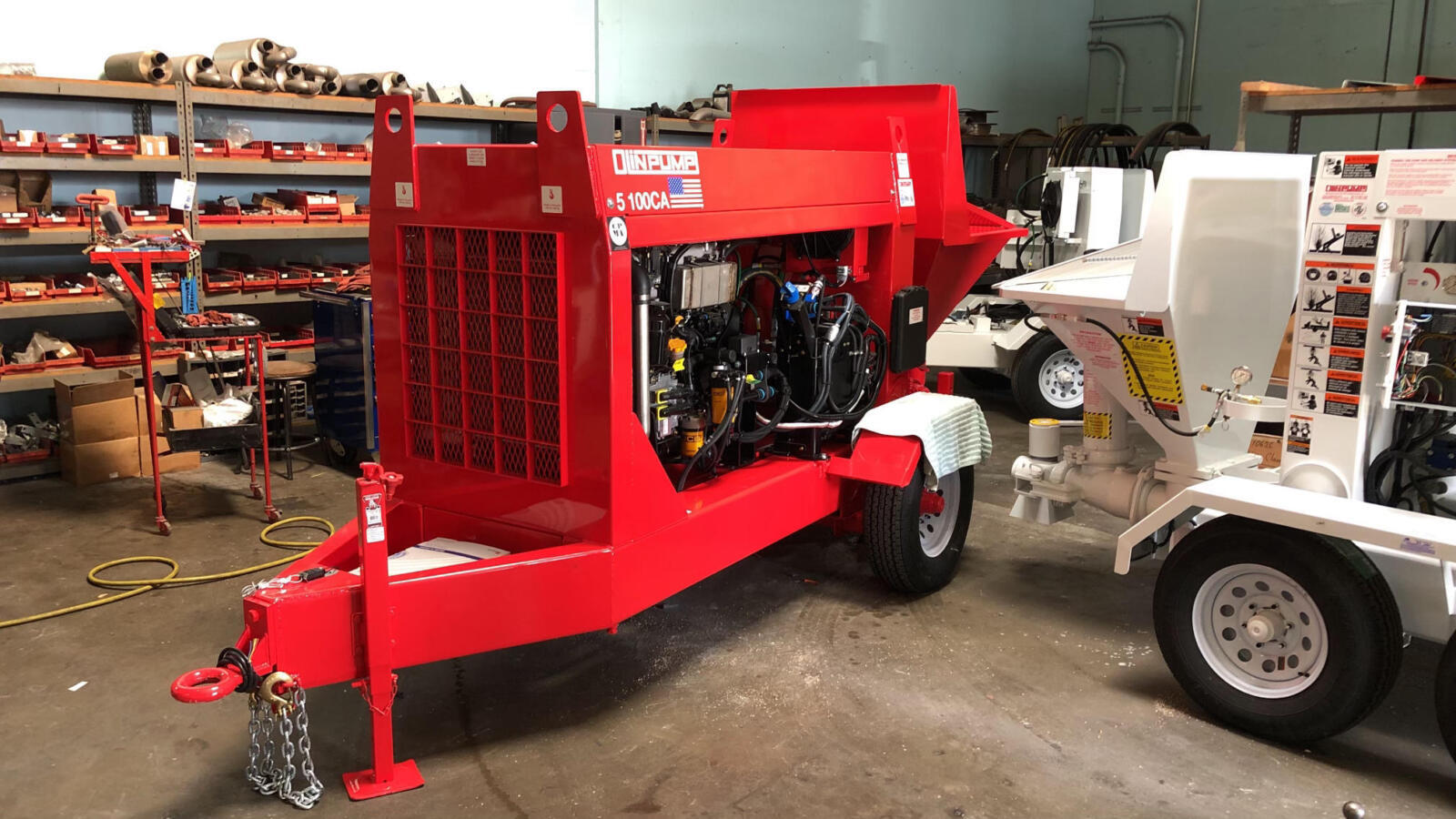
On a Continuous Flight Auger (CFA) or Full Displacement Pile (FDP) job, the margin usually comes down to piles per day.
"You may have planned for 10 a day, but if you can get 14, it's even better," says Joe Kinworthy, service manager at ECA's Jacksonville branch. "So the plan is you get in there, you get things set up efficiently, and then, boom, you go to work. You get in and you get out."
The grout pump sits at the center of that plan. Sizing the pump correctly for the pile is the first step. Keeping it fed with good grout, set at the right output and ready for the next pile is what turns rated capacity into daily production.
Keep Grout Supply Ahead of the Rig
A pump can only deliver the grout it has. On many jobs, crews stage two grout trucks at the pump at the same time. When one runs empty, the second is already in position to fill the hopper, and the rig never waits on a delivery.
The Olin pump's compact footprint helps. The pump can be set out of the way with lines run to the rig, leaving room for trucks to cycle in and out.
Watching the Clock on Every Load
Grout has a working life. Once water meets cement at the batch plant, hydration begins.
"When you add water to cement, it's a chemical reaction," Kinworthy says. "It starts heating up."
That is why placement time is limited. Depending on the material temperature, the requirement is a two-hour maximum from the time the grout was mixed at the plant.
Requirements can vary by project, so crews should confirm the limit in their own specifications.
Checking Grout With a Flow Cone
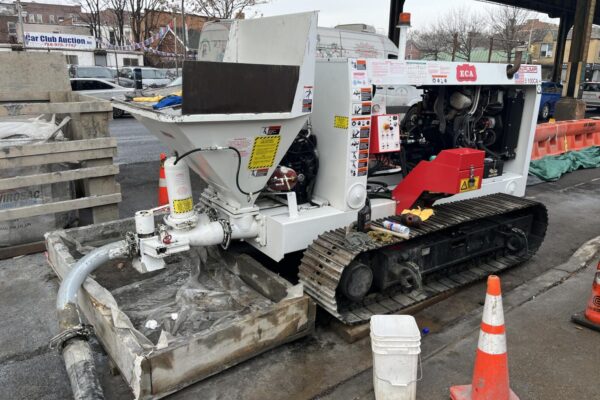
As a load approaches its time limit, some contractors check its fluidity with a flow cone, a funnel with a nozzle at the bottom. A crew member holds the outlet closed while filling the cone with a measured amount of grout, then releases it and times how long it takes to drain.
In Kinworthy's experience, the cone should empty in a matter of seconds. A slower time means the grout is stiffening.
"If it takes longer, then you're running the risk of the grout setting up in your hoses, lines and tools," he says. "So it can get very expensive."
Rejecting a questionable concrete load costs far less than clearing a plugged pump, grout line and auger, plus the loss of production that goes along with it.
Flow Control and Modern Engines
Older pumps could be matched to the rig by slowing the engine. Modern emissions-equipped engines are designed to run at or near full speed, so the aftertreatment system can complete its regeneration cycles.
To match output to the rig, current Olin pumps use a flow control. It adjusts hydraulic flow, and therefore pumping speed, while the engine holds its speed.
It also has to be set correctly, and that control gives the crew precise adjustment.
Finding the Pump's Sweet Spot
Because the engine runs near full speed, the flow control is where the crew tunes the pump to the job. The goal is the output matching what the engine, the grout line and the pile require.
Turning the flow all the way up can look like the fastest route to production, but it can ask more of the engine than it has available against the pressure in the system. Olin gives operators the information they need to find the right setting.
"There's pressure gauges on the pump itself to kind of give you an idea of how hard the pump's working," Kinworthy says.
He advises using those gauges, along with the sound of the pump, to dial in the flow during setup. Often a small adjustment is all it takes.
"I just turn it down a little bit to where it was within the sweet spot, and then everything is OK after that," he says, describing one recent setup. With the flow set in that range, the crew went on to install piles more than 80 feet deep with the pump running smoothly.
That kind of setup help is part of how ECA supports a new Olin. A technician on site for the first piles can tune the pump to the rig and show the crew what the gauges should read, so they can make the same adjustments on their own.
Keep the Pump Running Between Piles
Between piles, it can be tempting to shut the pump down while the rig moves to its next location. However best practice is to keep it running.
"You have cement in a piece of equipment," he says. "You should never shut it off."
When the pump stops, cement can settle out of the grout and collect at the bottom of the hopper, where it can form a plug. If the crew wants to reduce engine speed between piles, idling is the better option, and the pump stays ready for the next pile.
The Pump Operator's Role
While the rig drills, the grout pump operator keeps the hopper and equipment clean, using a hose to keep material fluid. The more important job is timing.
"He needs to be ready when the operator gets down to what we call tip, which is the maximum depth of the hole, and then pull out," Kinworthy says. "So he always has to make sure that that pump is ready to go."
An experienced pump operator also listens to the pump, watches the gauges and adjusts flow as conditions change.
End-of-Day Cleanout
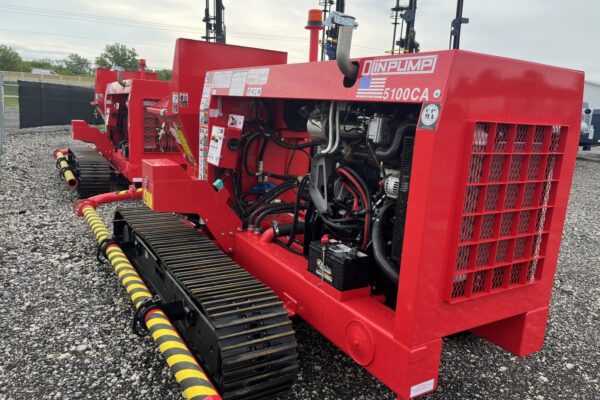
Kinworthy describes Olin pumps as essentially trouble-free as long as they are maintained. That maintenance starts with cleanliness, which matters on any equipment handling grout or cement.
The daily cleanout follows a simple sequence:
- Fill the hopper with water and pump a sponge or ball sized to the pipe or hose through the system.
- Keep pumping until nothing but clear water comes out of the auger or drilling tool.
- Open the manifold and clean it thoroughly.
- Check the O-rings and replace any necessary.
- Grease the components and reassemble the manifold for the next day.
"The manifold is very easy to take apart," Kinworthy says. "There's only O-rings that you have to worry about."
That simplicity carries over to training. A crew that understands the cleanout routine, the flow control and what the pressure gauges are telling them has covered much of what keeps an Olin productive.
Support When Production Is on the Line
Olin's value comes down to a simple, durable machine that rewards consistent care.
"They're pretty simple. They do the job," he says. "Like anything else, you take care of it, they take care of you."
When something does go wrong, he encourages contractors to call early.
"If you have a problem, give us a call as soon as possible, because sometimes we can help over the phone," he says. "We can give technical support right away."
Many members of ECA's team have worked for contractors themselves, and they understand what a stopped pump means for the schedule.
"Downtime is very expensive," Kinworthy says. "That's why there's always a sense of urgency to get back up and going."
The stalling pump that only needed a flow adjustment is the kind of problem ECA wants to solve before it costs a contractor days of production. As Kinworthy puts it, "It's painful to see people fail when you know they can succeed."
From pump selection and rig setup to field service, parts and crew training, ECA supports Olin grout pumps as part of a complete CFA and FDP operation.
Topics:
More Articles in Grout Pumps
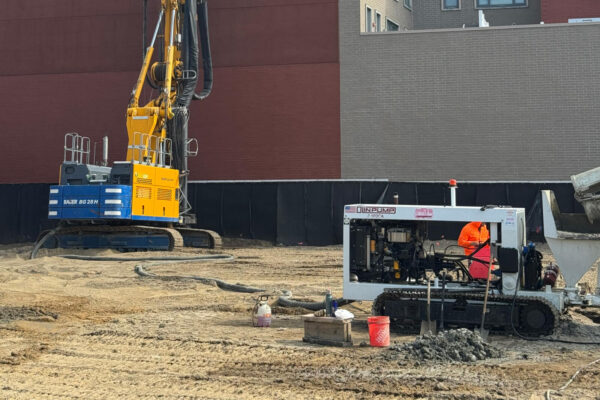
Choosing a Grout Pump for CFA and Full Displacement Piles
Learn how to size a grout pump for CFA and full displacement piles, from grout volume and overbreak to rig…
