
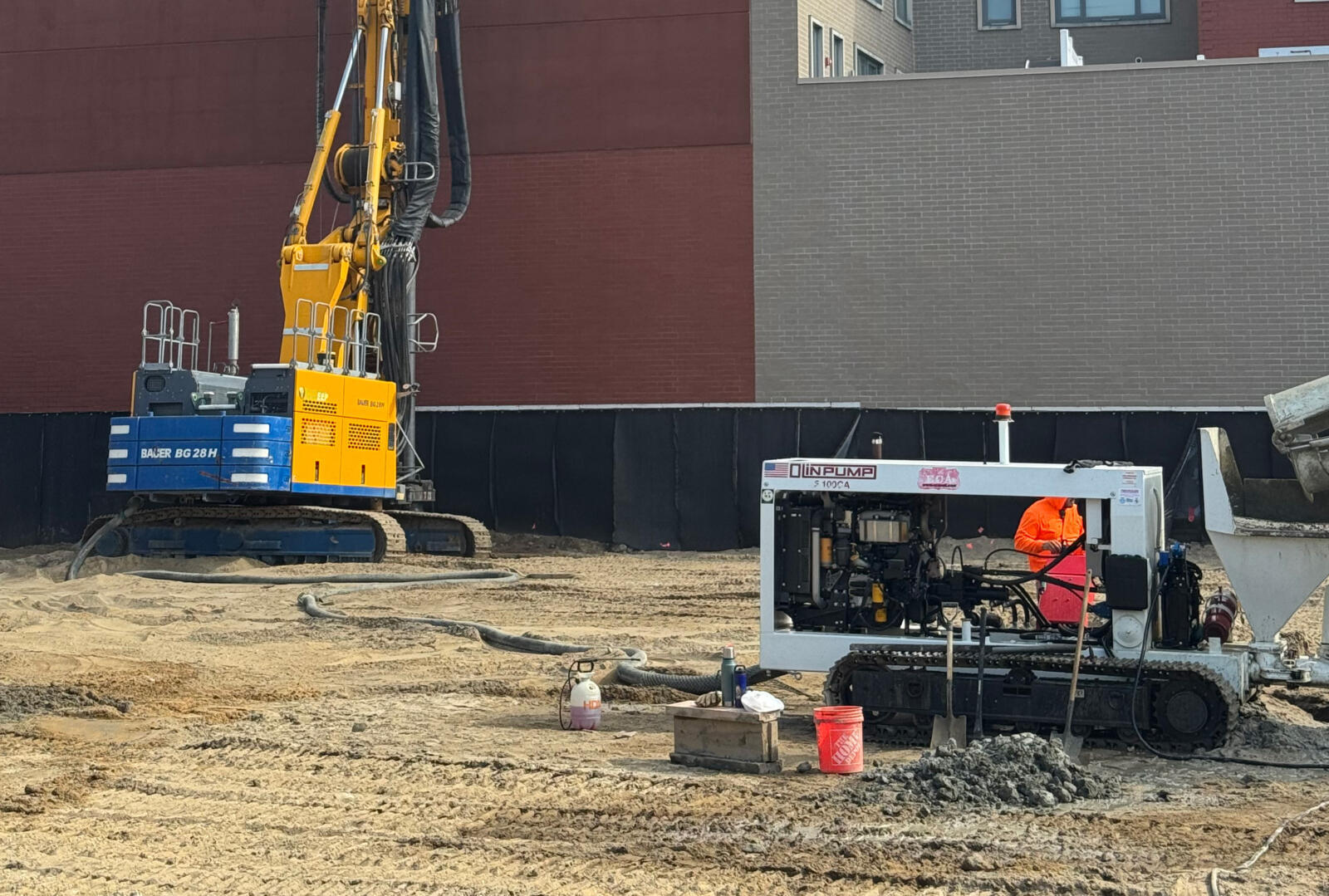
On a Continuous Flight Auger (CFA) or Full Displacement Pile (FDP) job, the drill rig gets most of the attention. But once the tool reaches depth, it is the grout pump that determines how quickly each pile gets finished.
Every pile ends the same way. Grout moves down through the hollow stem of the drilling tool, and the rig begins to withdraw as the hole fills from the bottom up. How fast that can happen depends on how much grout the pump can deliver and how well the pump and rig work together.
That makes pump selection a production decision as much as an equipment one.
Joe Kinworthy, service manager at ECA's Jacksonville branch and the company's resident Olin specialist, sizes and sets up Olin pumps for these applications. His approach starts with the pile, not the pump.
Why CFA and FDP Call for a Grout Pump
Olin pumps are often described as concrete pumps. On foundation jobsites, they are better understood as grout pumps.
Inside the manifold, a series of balls and seats control the flow of material as the pump strokes. That design suits fluid cement grout, and it also sets a limit. The mix should contain no aggregate larger than 1/4 inch.
That places Olin pumps squarely in CFA and FDP work. Contractors in different regions may use different names for the same installation process. Rigid inclusions, for example, are commonly installed using the same method BAUER calls full displacement, so the grout pump requirements are much the same.
Grout Delivery Sets the Pace
When a contractor selects a grout pump, the first consideration is volume.
The reason is straightforward. The rig cannot come out of the ground faster than the pump can fill the space the tool leaves behind. Withdraw too quickly and the pile risks voids or necking. Withdraw too slowly and the crew gives up production time on every pile.
"As it's pumping the grout in the hole, it's dictating how fast they can pull out of the ground," Kinworthy says. "So everything is based off of speed."
A slight surplus of grout is acceptable. The goal is to keep grout delivery a little ahead of the tool, never behind it.
Large-diameter piles make the point. On a 36-inch CFA pile, a contractor wants enough pump capacity that the rig is not sitting in the hole waiting on grout. Placement can also be monitored by pressure as well as volume, giving the crew another check on the pile.
Planning for Overbreak
A finished pile rarely takes only the theoretical volume of the hole. In practice, it takes more. Contractors call that additional material overbreak.
The allowance varies by project. Some contractors plan for 5%. Some engineers specify 10% or 15%. The figure depends on the scope of the work and the geographic area.
If a pile calculates at 5 cubic yards and the overbreak is 10%, the crew expects to place about 5.5 cubic yards by the time grout reaches ground level. That margin helps confirm the hole has been completely filled.
Overbreak also feeds directly into pump selection. More volume per pile means more volume per hour to maintain the same withdrawal rate.
How the Rig and Pump Work Together
Coordinating grout delivery with withdrawal once depended on people.
"Some customers use radios to tell the pump man ‘pump on or pump off," Kinworthy says. "Others let the operator use the pump remote. You don't have to do that anymore."
On modern BAUER rigs, a sensor on the grout line running up the mast registers the pressure increase from each pump stroke, and the rig counts those strokes. With the drilling tool's diameter and pitch and the job's overbreak entered into the control system, the rig calculates how much grout has gone into the hole and how fast it should come up.
The operator sees volume plotted against depth on the B-Tronics screen. BAUER's Drilling Assistant can also manage withdrawal automatically, so once it is activated, the tooling rises at the calculated rate hands-free.
That is why Kinworthy's setup on a new job starts with questions. One of the questions to ask is ‘what’s your overbreak?’ If the answer is 10 percent, he programs that into the B-Tronics, then measures the tool and enters its dimensions. From there, the rig and Olin pump work in tandem.
What Olin Model Numbers Tell You
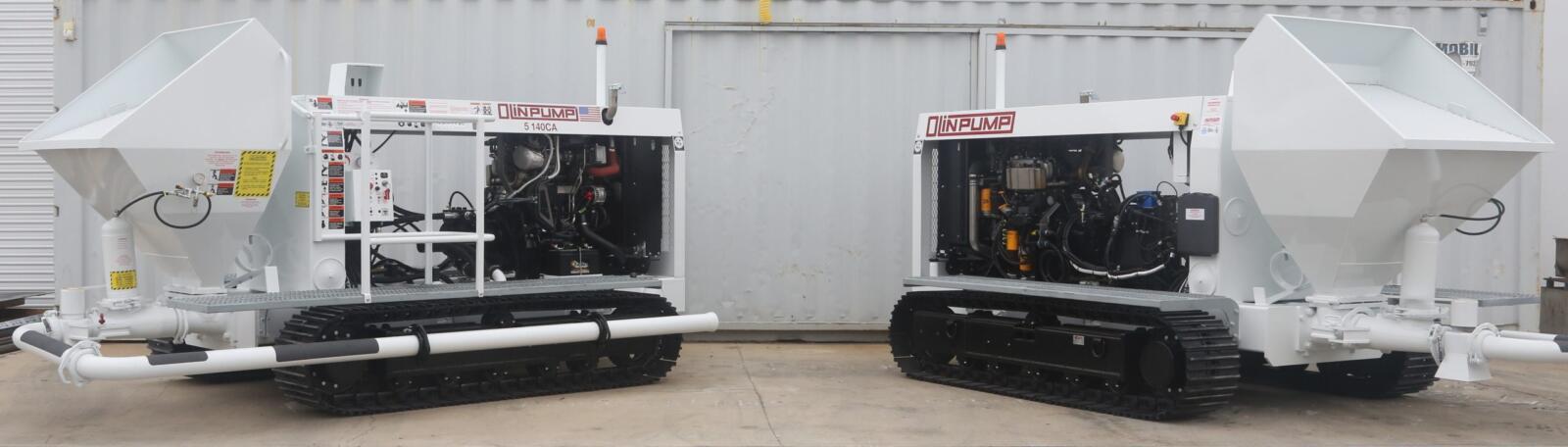
Olin's model designations make capacity comparisons straightforward. The second number in each model indicates the pump's rated output in cubic yards per hour at full speed. The 5-100, for example, is rated at 100 cubic yards per hour.
The lineup steps up from the 5-30 through models including the 5-60, 5-75, 5-100 and 5-140, with larger models above that. ECA's Olin offerings include the tracked 5-100CA and 5-140CA.
Rated output is a ceiling, not a setting. On the jobsite, the pump's flow is adjusted to match the rig and the pile.
Sizing Starts With Depth, Diameter and the Rig
When a contractor asks which pump fits a CFA job, Kinworthy narrows it down quickly.
"Mostly it's going to be depth, diameter and rig size," he says.
The three factors build on one another. A larger rig such as a BAUER BG 45 can drill deeper, larger diameter piles than a smaller BG 15H. The larger rig also works faster, so the pump has to keep up with higher grout demand.
"Everything is dictated by depth and diameter of the hole," Kinworthy says. "From there, it’s basically how you size the pump."
Depth and diameter determine the volume of each pile. The rig determines how quickly that volume needs to arrive. One other factor is the maximum speed of the machines pull out rate, but you should still spec a pump large enough to maximize production.
Track-Mounted or Trailer-Mounted?
Olin pumps are available on tracks or on wheels, and the choice depends on how the contractor runs the site.
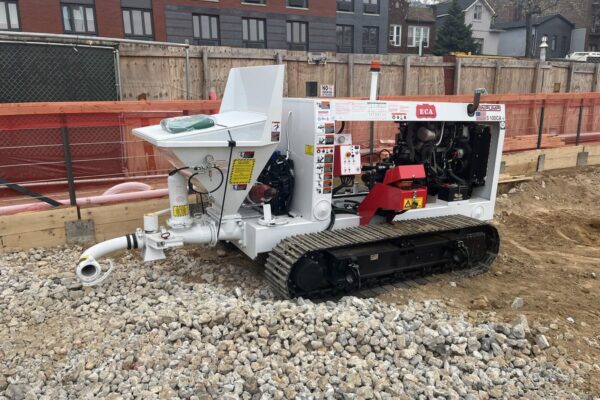
A track-mounted pump can follow the rig, which is quite the luxury on the job site. Many crews relocate the pump daily as the rig works across the site, and tracks make those moves simple.
A wheeled pump tends to stay put. Some contractors prefer to set it once, run longer lines and move it perhaps once a week.
Each option has tradeoffs. Tracks need to be kept clean of grout and cement, which adds to daily maintenance. A wheeled pump still needs care, but buildup around a stationary unit is less of a concern.
Tip: Plan the line layout. Whichever mounting the contractor chooses, how the line is run affects performance. Rubber hose has nearly four times the friction of slickline, so best practice is to keep rubber hose runs as short as possible. It is just as important to keep other site equipment from driving over the hose. That can squeeze moisture out of the grout inside and potentially cause a plug in the line.
Both designs share a small footprint, which matters on congested sites where the rig, grout trucks and crews compete for space.
Sizing the Pump to the Pile
The right grout pump is the one that keeps pace with the pile. Depth and diameter set the volume. The rig sets the rate. Overbreak, site layout and how often the pump needs to move fill in the rest.
ECA supports both sides of that equation, with BAUER drilling rigs, Olin grout pumps and service staff who set them up to work together. That lets contractors size the pump around the application rather than the other way around.
Once the pump is on site, how it is fed, adjusted and maintained determines whether it delivers that production every day.
Topics:
More Articles in Grout Pumps
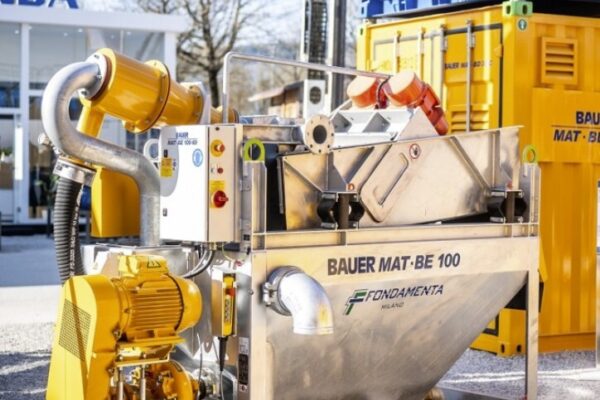
Managing Drilling Slurry: How Separation Systems Improve Foundation Jobsites
Learn how drilling slurry separation and desanding systems remove solids, recover fluids and improve material handling in foundation drilling and…
Foundation Grout and Slurry Mixing: MAT Equipment Explained
Learn how MAT mixing and pumping equipment supports foundation drilling, soil mixing and micropile applications with automated batching and colloidal…

Cased Continuous Flight Auger Drilling: Where CCFA Fits in Foundation Construction
Learn how Cased Continuous Flight Auger drilling (CCFA) improves verticality, productivity and control for secant pile walls and challenging ground…