
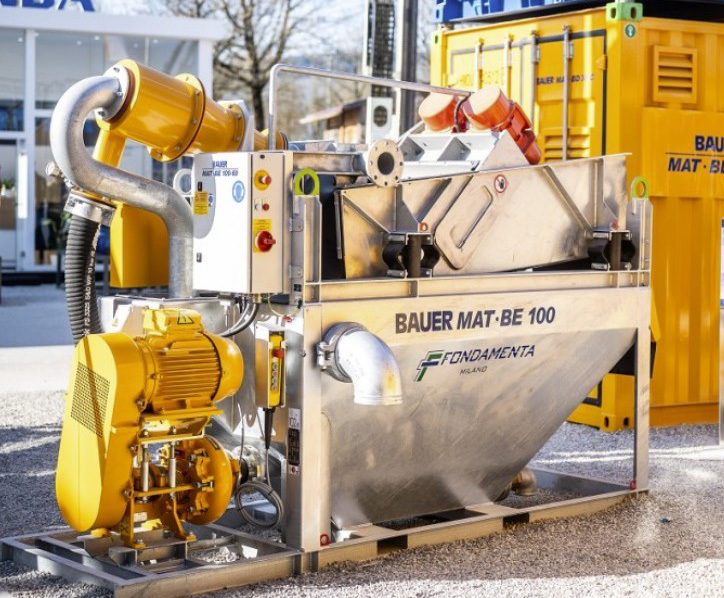
Drilling slurry can serve several important purposes during foundation construction. It can help stabilize an open excavation, transport cuttings out of a borehole and support the drilling process in difficult ground conditions.
But once slurry returns to the surface carrying soil, sand and other excavated material, contractors face another challenge: what to do with it.
Sending the entire mixture directly to disposal can be expensive and inefficient. Allowing solids to continually circulate through the drilling system can also reduce the effectiveness of the fluid. On projects that consume large volumes of slurry, replacing material rather than reusing it can add another layer of cost.
Separation equipment gives contractors another option.
“The idea is to separate the solids from the liquid,” says Gordian Ulrich, ECA Vice President of BAUER Product Sales and Service. “You want to get the solids as dry as possible, and then you can reuse your water or your polymer or bentonite slurry.”
For MAT, that separation process represents the third part of a larger material-management system built around mixing, pumping and separating.
Why Does Drilling Slurry Need to Be Separated?
During drilling, fluid can be pumped down the borehole and returned to the surface carrying excavated material.
That circulation performs an important function. Instead of allowing cuttings to remain in the hole, the returning fluid transports them to the surface, where they can be removed from the drilling process.
“If you remove the cuttings faster from the hole, you can penetrate faster,” Ulrich says.
The challenge is that the returning fluid is now carrying those solids.
A contractor could dispose of the entire mixture and continuously replace it with new fluid. On applications requiring substantial volumes of water or bentonite slurry, however, that approach can quickly become costly.
A separation system allows contractors to remove the excavated solids while retaining fluid that can potentially be returned to the drilling process.
The result is a cycle: fluid goes into the borehole, it returns carrying the cuttings, passes through separation equipment and can then be recirculated.
How Does a Desander Work?
A desander separates excavated solids from the liquid returning from a drilling operation.
BAUER MAT's BE 100 desanding unit is designed around this process.
Ulrich describes a typical operation beginning with water or slurry being pumped into the borehole. As the fluid returns, it carries soil and drilling cuttings with it. Instead of sending that material directly to a disposal area, the return flow is directed to the desander.
The BE 100 separates those solids from the liquid portion of the mixture.
“The solids that come out are relatively dry, almost like beach sand,” Ulrich says. “And the water can be reused and pumped back into the hole.”
The system therefore serves two purposes at once. It prepares excavated material for easier handling while recovering fluid that may still have value to the drilling operation.
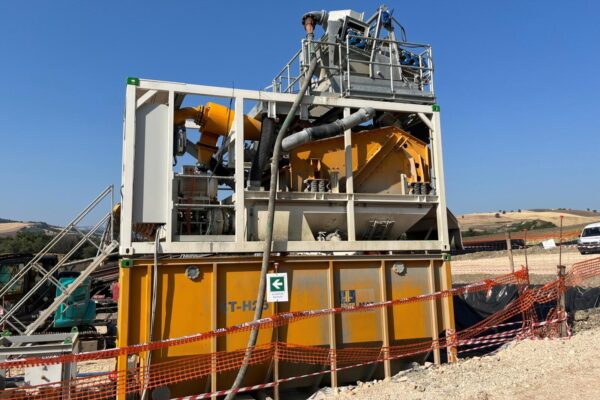
Drier Material Can Mean Lower Disposal Costs
Separation is not only about keeping the drilling fluid clean.
It can also change the economics of waste disposal.
Material saturated with water can be more difficult and expensive to transport and dispose of than relatively dry excavated material. A contractor paying to remove wet slurry is effectively paying to haul away both the soil and a substantial amount of liquid.
“If you have to dispose of slurry, the price per ton is significantly higher than if you dispose of relatively dry material,” Ulrich says.
By separating solids from the liquid portion of the drilling return, contractors can reduce the amount of water contained in the material being hauled from the site.
That can become particularly important on projects generating large quantities of drilling spoils.
It also illustrates why slurry management should be considered as part of project planning rather than as something that begins only after material starts coming out of the ground.
Closing the Loop on a Micropile Operation
Micropile drilling provides a useful example of how pumping and separation equipment can work together.
A pump such as the MAT EP 14-600 eccentric screw pump can supply water or slurry to the drilling operation. The fluid travels down the borehole and helps transport cuttings back toward the surface.
The returning mixture can then be directed into a BE 100 desander.
The solids are removed, and the recovered fluid can potentially be returned to the drilling process.
Ulrich describes it as a straightforward relationship between circulation and production.
The more effectively a contractor can remove cuttings from the borehole, the less material remains behind to interfere with drilling. Increasing fluid circulation can therefore help support penetration rates, provided the contractor also has a system capable of handling the returning material.
Rather than viewing the pump and desander as independent accessories, contractors can look at them as components of the same fluid-management process.
One moves material through the drilling system. The other helps prepare that material to be used again.
Moving Slurry Around the Jobsite
Not every slurry-management challenge involves pumping material directly down a borehole.
Once fluid reaches the surface, contractors may need to move it to a desander, settling tank or another part of the jobsite.
MAT's HP 50 and HP 70 hose pumps are designed for that type of material handling.
Unlike the EP 14-600 eccentric screw pump discussed in connection with mixing and drilling operations, the HP series uses a relatively simple hose-pump design.
That simplicity is useful when handling abrasive slurry containing solids.
Ulrich describes the hose itself as the primary wear component. Because the slurry travels through the hose rather than a complicated pumping mechanism, the system can handle dirty material while remaining comparatively straightforward to maintain.
The pumps can also accommodate relatively large solids.
That makes them useful for transferring slurry from the drilling area to the equipment responsible for separation or settlement.
“You can use it to pump slurry from your borehole over to your desander or to your settling tank,” Ulrich says.
The HP 50 and HP 70 differ primarily in their output capabilities, giving contractors options depending on the volume of material that needs to be moved.
Slurry Management Extends Beyond Foundation Drilling
Although MAT equipment is a natural fit within foundation construction, the underlying process is not unique to vertical drilling.
Any application that uses fluid to transport excavated solids can create a need for pumping and separation.
Ulrich identifies three primary markets where that principle applies: foundation construction, environmental and remediation work, and tunneling.
Environmental work can require contractors to manage contaminated or otherwise sensitive material while controlling the water used during excavation and drilling.
Tunneling takes the same basic concept and turns it horizontally.
Slurry Separation in Tunneling
In slurry-supported tunneling, fluid can be used to transport excavated material away from the tunnel face.
Bentonite slurry can carry solids from the excavation face back to separation equipment. The solids are removed and the bentonite can be reused in the tunneling process.
The scale of the excavation can vary considerably.
Ulrich points to both microtunneling for utilities and large-diameter tunnel boring machine projects as applications where separation equipment may be required.
That makes slurry separation relevant well beyond traditional foundation contractors. The excavation may be a small-diameter borehole, a diaphragm wall trench or a large horizontal tunnel, but the fundamental challenge remains similar: excavated solids need to be transported, separated and managed.
Slurry Management Should Be Part of the Drilling Plan
Drilling productivity is often discussed in terms of the machine itself: torque, crowd force, rotary speed, drilling depth and tooling.
Those factors matter, but they do not represent the entire production system.
If a drilling method relies on fluid circulation, contractors also need to consider how much fluid is required, how quickly it must move through the system, what happens when it returns to the surface and how the excavated solids will ultimately leave the site.
A properly planned slurry-management system can help contractors:
- Remove drilling cuttings efficiently.
- Recover water or slurry for potential reuse.
- Produce drier solids that are easier to handle.
- Reduce the amount of liquid sent for disposal.
- Move slurry efficiently between drilling, separation and storage equipment.
- Maintain a cleaner, more organized drilling operation.
The right configuration depends on the application. A micropile contractor may need a very different system than a diaphragm wall contractor or a tunneling operation. In either case, the principle is the same.
Looking Beyond the Drill Rig
MAT's BE 100, EP 14-600 and HP hose pumps demonstrate how supporting equipment can influence the efficiency of the entire drilling operation.
The drill rig creates the hole, but production does not end at the rotary head or drilling tool. Fluids need to be supplied. Cuttings need to be removed. Slurry needs to be transported. Solids may need to be separated, and reusable material needs to make its way back into the process.
For ECA, understanding those relationships is part of taking an application-first approach to foundation equipment.
A contractor does not simply need a desander or a pump. The contractor needs a system capable of managing the material generated by a specific drilling method, at the production rate required by the project.
By looking at the entire process, from fluid circulation and cuttings removal to separation, reuse and disposal, contractors can build a more efficient operation around the drilling equipment doing the work.
Topics:
More Articles in Bauer
Choosing a Grout Pump for CFA and Full Displacement Piles
Learn how to size a grout pump for CFA and full displacement piles, from grout volume and overbreak to rig…
Foundation Grout and Slurry Mixing: MAT Equipment Explained
Learn how MAT mixing and pumping equipment supports foundation drilling, soil mixing and micropile applications with automated batching and colloidal…

Cased Continuous Flight Auger Drilling: Where CCFA Fits in Foundation Construction
Learn how Cased Continuous Flight Auger drilling (CCFA) improves verticality, productivity and control for secant pile walls and challenging ground…