
Mixing Matters: How MAT Equipment Supports Foundation Drilling and Soil Mixing
On a foundation construction site, the drilling rig often gets most of the attention. But on many applications, what happens beside the rig can be just as important to production.
Drilled shafts, diaphragm walls, soil mixing and certain micropile applications can depend on carefully prepared slurry or grout. That material may need to stabilize an open excavation, become part of the finished foundation element or be delivered continuously to drilling equipment working at high production rates.
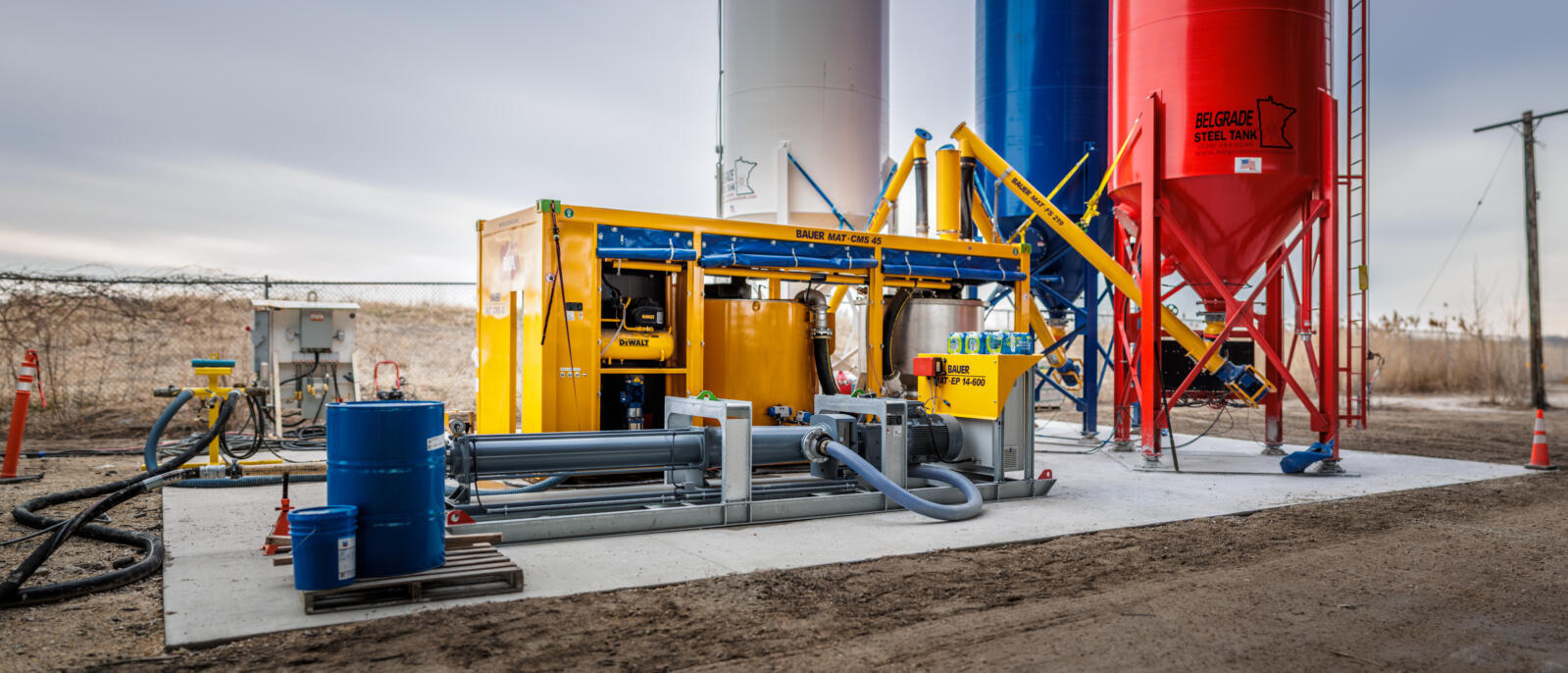
That is where BAUER MAT equipment fits into the foundation construction process.
“MAT provides the equipment you need to mix a slurry or grout, to pump that slurry and, if you have to, to even separate that slurry again,” says Gordian Ulrich, ECA Vice President of BAUER Product Sales and Service. “It’s mixing, pumping and separating and all that at the highest levels of production.”
Understanding those processes starts with understanding why foundation contractors need slurry and grout in the first place.
Why Is Slurry Used in Foundation Drilling?
Consider a deep drilled shaft or diaphragm wall excavation.
When a contractor drills inside temporary steel casing, the casing helps support the surrounding ground and prevents the excavation from collapsing. But installing casing across the full depth of a large or exceptionally deep excavation may not always be economically practical.
In those situations, drilling slurry can perform the stabilizing function.
Ulrich uses the example of a 300-foot-deep panel excavated with a trench cutter or grab. There is no steel casing or formwork extending to the bottom of that excavation. Instead, bentonite slurry is used to maintain trench stability while excavation progresses.
Bentonite is a clay material that absorbs water very well and acts like a coat of sealing paint on the borehole wall called the filter cake. When properly mixed with water, the resulting slurry can be used to help stabilize an open borehole or trench.
“The question is, what keeps that trench open?” Ulrich says. “The solution to that is a slurry, which needs to be properly mixed and monitored.”
The same basic principle applies across different foundation applications.
Large-diameter drilled shafts can use slurry when casing is not required or becomes impractical because of diameter or depth. Diaphragm wall and cutoff wall construction can rely on slurry to maintain trench stability during excavation. Ulrich notes that even some small-diameter drilling applications can use bentonite slurry when casing is not in place.
Whether the excavation is circular or rectangular, large or small, the objective is similar: maintain a stable excavation until the next stage of construction can take place.
Slurry and Grout Serve Different Purposes
Although the terms can sometimes get grouped together on the jobsite, slurry and grout do not necessarily perform the same function.
Bentonite slurry may be used primarily as a temporary drilling fluid to maintain borehole or trench stability and sometimes even for transporting the cuttings out of the hole. Cement-based grout, meanwhile, can become part of the finished foundation element.
That distinction also affects the equipment required to prepare the material.
MAT batching equipment is designed to mix powder materials with water. Depending on the application, that can include bentonite, cement or fly ash. It is not designed to batch mixes containing sand or larger aggregate.
That is why a typical CFA operation using a sand-containing grout or concrete mix requires a different type of batching and pumping equipment, such as the Olin Pump 5 140 to pump ready mixed grout. However, cement-and-water grout used in applications such as micropiles can be well suited to MAT mixing equipment.
Understanding the material specification is therefore one of the first steps in determining the right mixing and pumping system for an application.
Why Colloidal Mixing Matters
Mixing water and cement or bentonite sounds simple. Producing the same high-quality material batch after batch is more complicated.
Ulrich describes the most basic approach in equally basic terms: add water, add powder and mechanically mix the two together. The problem is not whether those ingredients can be combined, but rather how effectively they are mixed.
“The question is always how much energy do you bring into that slurry,” Ulrich says. “A colloidal mixer is simply the highest amount of energy you can bring in there in a very short time.”
That mixing energy, or shear energy, can directly influence the properties of the finished material.
For cement-based mixes, Ulrich says improved mixing can contribute to better results during strength testing. With bentonite, colloidal mixing offers another important advantage: hydration.
Without sufficient shear energy, a bentonite mix may need to sit for hours while the material absorbs water and develops the required properties. A high-shear colloidal mixer accelerates that process so the slurry can be put to work much sooner.
“When you mix bentonite in a colloidal mixer, the answer is right away,” Ulrich says. “After you mix it, you can use it right away.”
That capability is particularly valuable on high-production projects where slurry demand is continuous.
The MAT CMS 50 Brings Mixing and Batching Together
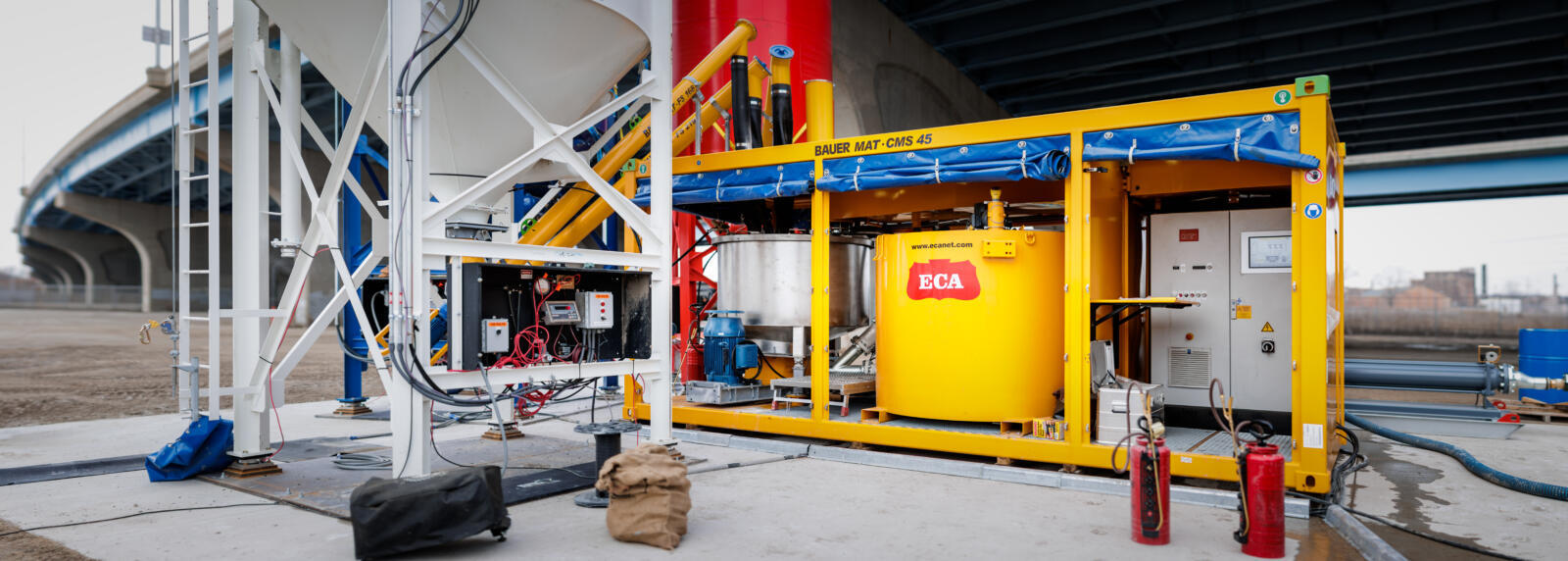
For ECA, one of the primary MAT systems for these applications is the CMS 50 automated batch plant.
The CMS 50 evolved from the CMS 45, increasing rated output from 45 to 50 cubic meters per hour while maintaining the same basic footprint. The system integrates the mixer, agitator tank and controls into a single 20-foot containerized unit.
That containerized design simplifies mobilization.
Instead of transporting and assembling multiple major components independently, the contractor can move the primary batch plant as one unit. Once positioned, silos and screw conveyors can supply the dry material while a delivery pump moves the finished mix where it is needed.
The combination of high output and a relatively compact footprint makes the CMS 50 particularly useful for high-volume foundation applications.
Soil mixing is a prime example.
Single-column mixing, Multi Shaft Mixing (MSM) and Cutter Soil Mixing (CSM) can require substantial volumes of material as large tools advance through the ground. On those projects, the batch plant must be capable of keeping pace with the drilling equipment.
Ulrich puts the scale into perspective with a 10-foot-diameter soil mixing tool advancing at approximately one foot per minute.
“You can imagine how much volume is required a minute, an hour, throughout the day on these jobsites,” he said. “It’s a lot.”
A high-production drilling system can only remain productive if the supporting equipment can consistently supply the material it requires.
Automation Helps Maintain a Consistent Mix
Output is only part of the equation. The material also needs to meet the project's specified mix design.
Ulrich compares the process to following a baking recipe.
“If you do not follow the exact measurements and ingredients as per the recipe, the outcome will look different, taste different, be different,” he says. “In the grouting world, it’s the same thing.”
Depending on the application, the mix design may specify water, cement, fly ash or liquid additives such as plasticizers. Those proportions can affect properties including strength, permeability, pumpability and viscosity.
With an automated MAT batch plant, the required recipe is entered into the control system. The mixer is mounted on calibrated scales, allowing ingredients to be measured by weight. The system monitors each batch and can compensate for small variations in material delivery.
That matters because dry material does not necessarily move through a silo and screw conveyor at an identical rate every time.
According to Ulrich, the automated system recognizes those differences and adjusts accordingly, helping maintain accuracy of less than 3% across the day's production.
That gives contractors a repeatable process instead of relying on an operator to manually estimate water levels or count bags of material for every batch.
Follow-up testing for properties such as strength, viscosity and density can then verify that the produced material continues to meet project requirements.
Automation Can Change the Operator's Role
Automated batching does not eliminate the need for an operator. It changes what that operator is responsible for.
Once the CMS 50 has been configured with the required recipe, much of the batching process operates automatically. The operator can oversee production, maintain the system and perform necessary cleaning rather than manually measuring and adding every component of every batch.
There is also a worker-safety component.
Manual batching can require workers to repeatedly lift and break bags of cement or other powdered materials, often while working around mud, elevated mixer openings and airborne dust.
“The bigger problem, in my opinion, from a contracting perspective is you have a guy breaking bags, so you have a guy breaking his back,” Ulrich says.
For Ulrich, moving toward automated batching is as much about giving crews better tools as it is about production.
“We should give every tool possible to our guys if it makes their life safer and easier,” he says. “I would hope that contractors see the benefits of automated batch plants and give their guys the right tools to be productive.”
Getting the Mix From the Batch Plant to the Rig
Once slurry or grout has been properly mixed, it still needs to reach the drilling operation.
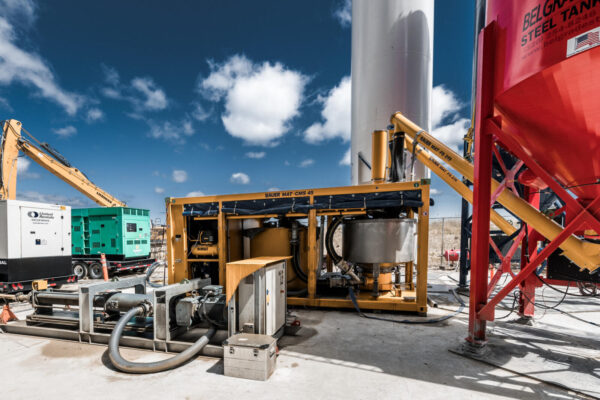
The MAT EP 14-600 eccentric screw pump is commonly paired with the CMS batch plant for that purpose. It moves the finished slurry or grout from the batch plant's agitator tank to the drill rig or other equipment requiring material.
The EP 14-600 can deliver up to 600 liters (160 gal) per minute at a maximum pressure of 14 bar (200 psi). Although it is frequently used alongside the CMS, it is a standalone pump and can serve other applications.
One of those applications is micropile drilling.
Contractors can use the pump to send water or slurry down the borehole during drilling. The returning fluid carries cuttings toward the surface. Increasing circulation and removing those cuttings efficiently can allow the drilling operation to advance more effectively.
“If you remove the cuttings faster from the hole, you can penetrate faster,” Ulrich says.
That versatility allows the EP 14-600 to support both high-volume soil mixing operations and smaller-diameter drilling applications where fluid circulation is an important part of the drilling process.
The Batch Plant Is Part of the Production System
Foundation equipment selection often begins with the drilling rig, and for good reason. Torque, crowd force, drilling depth, tool diameter and ground conditions can all determine whether a rig is capable of performing the work.
But applications that depend on slurry or grout require contractors to look beyond the drill rig itself.
A soil mixing rig capable of high production needs a batch plant capable of supplying the required volume. A demanding mix specification requires equipment capable of repeatedly producing the correct recipe. And the finished material must be delivered to the drilling operation at the required rate.
The CMS 50 and EP 14-600 address those requirements as complementary parts of the production system.
For contractors, the larger lesson is to size and configure the entire operation around the application. The drill rig, mixing plant, pumping equipment, material requirements and expected production rate all have to work together.
That application-first approach is ultimately where ECA's experience with both BAUER drilling equipment and MAT mixing and pumping systems becomes valuable. Understanding what happens at the drill is only part of understanding the job. The supporting equipment has to keep up.
Topics:
More Articles in Bauer
Choosing a Grout Pump for CFA and Full Displacement Piles
Learn how to size a grout pump for CFA and full displacement piles, from grout volume and overbreak to rig…
Managing Drilling Slurry: How Separation Systems Improve Foundation Jobsites
Learn how drilling slurry separation and desanding systems remove solids, recover fluids and improve material handling in foundation drilling and…

Cased Continuous Flight Auger Drilling: Where CCFA Fits in Foundation Construction
Learn how Cased Continuous Flight Auger drilling (CCFA) improves verticality, productivity and control for secant pile walls and challenging ground…